Tuesday, September 20, 2016

Blog Post about Finite Math Elective
Mrs. Shira Teichman
September 15, 2016


The Finite Math Elective offered to 11th graders is not really a new course; it follows the basic outline of a Finite Math class taught to seniors. However, in the few days of school that we've had, the elective has already diverged into a vastly different place due to the small class size and heightened level of motivation of these students to choose to study an additional math class during their junior year.
After learning the first unit on Exponential Functions and discussing the mathematical implications of exponential growth and decay - in situations like depreciation of a car’s worth, loss of ibuprofen in one’s body over time, and rapid growth of bacteria - I thought it would be neat to expand beyond the “real-world” word problems that we were practicing.


In a two-day mini-unit, we used a pre-made lesson that I discovered on Mathalicious to explore the concept of memory accuracy. In short, according to memory specialists and neuroscientists, the fidelity of a particular memory in fact decreases exponentially with each remembrance. This was mind-boggling to me and the students, but we could not argue with facts that we listened to on podcast interviews and video clips with said scientists. The lesson was embedded with dynamic Desmos graphs as well as accompanying worksheets with graph paper; in this way, the students were able to explore and actually interact with the mathematical ideas of exponential decay using the powerful graphing calculator before sketching graphs on their individual papers. Eventually, the concept began to sink in.


On day two of our lesson, we deepened our understanding of the significance of this new and counter-intuitive idea of memory loss. We thought about eyewitnesses being questioned repeatedly. We posited that this notion may be why therapists ask patients with PTSD to continuously recall an event in the hopes of diminishing the vividness of the memory. We even spoke about Holocaust survivors, and questioned whether the graph behaves the same for a memory of a “regular” event versus a “very traumatic” event.

At the close of the lesson, we watched a clip of “60 Minutes” where a newscast interviewed several people who have super autobiographical memory, a condition in which their memory remains perfectly untainted despite the number of times it is recalled. This was the clincher. A deep discussion ensued, during which time the students argued whether this abnormality was a “curse” or a “gift,” and whether they’d elect to have it if given the choice. During this time of year, when the High Holidays and Days of Judgement are just around the bend, it was especially interesting for us to think about how we would live our lives if we had this condition. Would it debilitate us, or spur us to live that much more mindfully, as an interviewee had said it did? I questioned my students about why G-d did not make this condition the norm, and instead made the default for memory accuracy a model of exponential decay. We agreed that, among other things, if we were to remember everything - including every consequence of our every action - we would lose a bit (if not all) of our temptation to repeat a bad action, thereby robbing us of our characteristically human ability to chose (“bechirah”). Finally, we brainstormed ways to avoid this inevitable loss of accuracy, and decided that writing down an event (in something like a journal) could help us preserve the memory forever.

In reflecting on this past unit, students wrote that “Finite Math [Elective] takes math up ten notches” and that “is a big help in understanding math as whole.” The smaller size of this elective class gave us all a “safe space” to get thoroughly engaged in what became a highly personal application of a math topic. Above all else, I was deeply moved by my students’ level of sophistication in processing such a jarring concept, relating it to themselves, and allowing me to push them to think about it in the context of their religious and interpersonal growth. I am always inspired by math, and am infinitely more inspired by the synthesis of math and daily life; I am glad to see that my students were able to be exposed to this marvelous synthesis, too.   

Friday, April 15, 2016

The Geometry inherent in Torah!

One of the benefits of the Frisch education is seeing the connection between Secular and Judaic Studies. Our goal is for students to see the connection between the different disciplines that they are learning and to apply what they learn in one class to other classes.


 This past week, two freshman Geometry classes participated in a two-session interdisciplinary class showing the deep connection between Geometry and Talmud. The first session was led by Rabbi Gedaliah Jaffe, a member of the Frisch Tanach and Talmud faculty. As a way of introduction, Rabbi Jaffe told the students a midrash which described the Menorah as a symbolism of knowledge, the center branch symbolizing Torah and six other branches representing other forms of knowledge including Arithmetic, Logic, and Geometry. Deepening our understanding of Torah, explained Rabbi Jaffe, allows us to further our understanding of other disciplines. The Chazon Ish was someone who embodied this reality; students were amazed to learn of the his ability to prescribe detailed descriptions of how to perform a brain surgery when he had no official medical background or degree but was “simply” a man immersed in Torah study. After he discussed the importance of Geometry in understanding Torah, Rabbi Jaffe highlighted several places in the Talmud where Geometry is needed to define halachic applications necessary for our performance of mitzvot. Rabbi Jaffe taught students the Talmudic measurements of an “amah” and “tefach” and the reason that those were used instead of inches or meters. He showed them topics in Masechet Eruvin in which the sages determined whether walking or continuing to travel on Shabbat was permitted, based on complex Geometric calculations.

Throughout the lecture, Rabbi Jaffe discussed the relevance of these ideas in modern times. He spoke about walking from Highland Park to Edison (the community where he serves as a shul Rav) or Camp Morasha to Camp Lavi. That night, the students were instructed to write about the part of the lecture that they found most interesting. Their wide range of responses - from the intricate math calculations to the anecdotal stories about our ancestors - showed us how our students have varying interests and are truly diverse learners.


The next day the two classes again combined and Mrs. Teichman and Mrs. Katz, the teachers of these two math classes, helped the students apply some of the mathematical topics that were discussed the previous day. The students were impressed by the accuracy of the rabbis’ solutions from over 1,500 years ago. Not only did the students see how the skills that they are learning in the math classroom can be applied to other classes, but they hopefully saw how Torah permeates and has practical ramifications on our daily lives in and out of the walls of Frisch.

Monday, April 4, 2016

Frisch team "Mathletes" went to Yale for the weekend!

This weekend Mrs. Sabrina Bernath, the Chair of the Frisch Math Department, and a team of six juniors went to Yale University to take part in the “Math Majors of America Tournament for High Schools” (MMATHS). MMATHS is an annual event organized by students at Yale University, Columbia University, and the University of Florida. The goal of the competition is to “provide an engaging platform for high school students of all mathematics backgrounds to compete together and develop a deeper interest and appreciation for mathematics.” 

Until this year, the MMATHS exam was given only on a Saturday but through the incredible efforts of Yale students Esther Issever, a freshmen, and Mitchell Harris, a graduating senior, students from Orthodox day schools were able to compete on Sunday. 

What made this opportunity even more special was that the students and Mrs. Bernath were invited to be guests of the Slifka Center for Shabbos. All lodging was arranged by Esther and Mitchell and meals were sponsored by the Slifka Center. It was relaxing but busy Shabbos as the Frisch mathletes schmoozed with Yale students, learned from a scholar-in-residence from the Drisha Institute, played board games and ate amazing food.  

The Slifka Center at Yale Univeristy
After davening Sunday morning, Frisch was joined by teams from Yeshiva of Flatbush and Kushner. Each school had six students on their respective teams. In the first round of the competition, students worked individually and had seventy-five minutes to answer twelve questions.  

Here is a question from the individual round:
“Let w, x, y, and z be distinct integers. Call an ordering statement any true statement of the form “a<b” where a and b are each one of w, x, y,and z. What is the minimum number of distinct ordering statements necessary to determine the correct ordering of all the numbers w, x, y, z?”

As you can see from this question, this was no standard math test!

Next was the “mixer” round, where the teams were scrambled.  Each of the new groups had seventy-five minutes to work on twelve challenging problems.  The students quickly got down to business with the members of their new teams. It was evident that the students from different schools were bonding quickly over the tough problems as the room started to fill with laughter. Mark A. and Alyssa S. were members of the winning mixer round.
Mark A. and Alyssa S. competing in the "mixer" round.
An example of a question from the “Mixer” round is the following:

“On the back of this page, prove there is no function f(x) for which there exists a polynomial p(x) such that f(x) = p(x)(x +3) + 8 and f(3x) = 2f(x).”

The final round was the “Mathathon," with the original school team working as a group on seven problems sets, each consisting of three questions.  After completing a problem set, a runner brought up the team’s answers and got the next set of questions. It was a fast-paced round where the leading team changed minute to minute.

Frisch mathletes competing in the team round.
Additionally, the five strongest students from the individual round were sequestered during the competition and given a proof-based test as a tie- breaker to see who ranked the highest scorer among the three schools. Dov G., a junior at Frisch, came in second place.

Back at Frisch with new Yale swag, MMATHS T-shirts, and a metal for Dov!
Frisch lost by a small margin in the team category, but they were proud of their accomplishments in such a unique and elite competition and grateful to have spent Shabbat at Yale. It was an incredible and fun opportunity on many levels.

Wednesday, March 16, 2016

Finite math- Endless Exploration and Integration

Finite Math Class - Endless Exploration and Integration

Exponential Growth is the first unit of study of the senior “Finite Math” class at Frisch.  The phrase “exponential growth” is also the best way to describe the first semester of this popular senior math course. Ever since it was initiated in 2011 by Mrs. Sabrina Bernath, Chair of the Math Department, it has been rapidly gathering momentum and providing students with an ever-growing curriculum of real-world topics in mathematics. Teachers Mrs. Chanie Schlesinger and Mrs. Shira Teichman have been teaching parallel Finite Math classes for the past couple of years. Recently they have tweaked the robust Statistics Unit which introduces seniors to topics like Normal Distribution, summation notation, and Z-scores - topics which they will definitely encounter and perhaps explore more in depth in higher education.

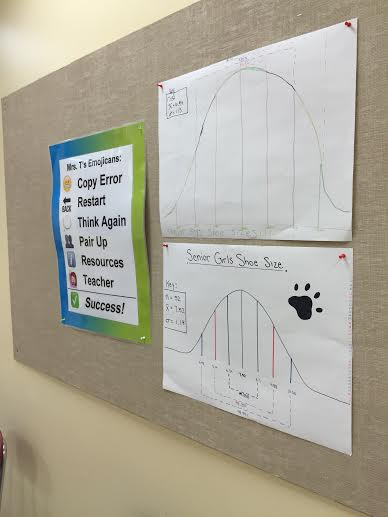
The unit began with an exploration of the “Normal Bell Curve” and data that is said to be "normally distributed" (i.e. certain percentages of the data fall in distinct intervals in the bell curve surrounding the data’s mean/average). After thorough study of this topic, Mrs. Schlesinger and Mrs. Teichman wrapped up the unit by having each of the students in their respective classes collect data from the entire senior grade, analyze the data sets, and compare the findings to a "normal distribution". Students from Mrs. Schlesinger’s class entered their grade-mates’ heights in a shared Google Spreadsheet, while students from Mrs. Teichman’s class entered their grade-mates’ shoe sizes in an identical Sheet.  The students then found the mean and standard deviation of their class’s respective data, and set about to construct their own Bell Curve.   


“We anticipate having great discussions about things like sample size versus total population, and data which is skewed by outliers,” Mrs. Teichman emailed Mrs. Bernath a day before the class drew the Bell Curve. In fact, the data did not abide by the general distributions in normally distributed data; each of the classes discussed why this occurred and found it interesting to learn that their grade was so “not normal,” at least when it came to some of their physical characteristics.  This was Phase One in a two-phase project designed by Mrs. Schlesinger, and the goal of this phase was to not only provide the students with an understanding of normal distributions, but also to give them an opportunity to collect, analyze, make predictions, compare, and present findings about real and relevant data.


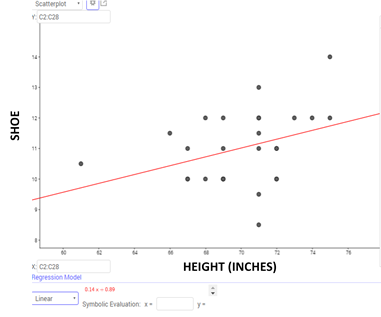
Phase Two of this project came a couple of weeks later. The two Finite Math classes spent several days learning about  Non-Linear Regression Analysis which analyzes the relationship - as seen in the correlation coefficient - between two sets of data (bivariate data) when studied together. The teachers had deliberately chosen to analyze shoe sizes and heights in the prior unit, because these usually have a strong correlation. Using the data collected by their students, the teachers combined the lists and created a Scatterplot to show the strong linear relationship between shoe sizes and heights. They then wrote a more detailed analysis, including a prediction about data that was  not among the original bivariate data.


Students were amazed to see the link between the data they had gathered as separate classes weeks before. Capitalizing on the students’ enthusiasm, Mrs. Schlesinger and Mrs. Teichman challenged students to work with a partner and analyze their OWN choice of bivariate data to find out how closely linked they are, if at all. Bivariate data sets ranged from "number of friends on Facebook vs. number of Likes on one's profile picture" to "age vs. number of hours of sleep" to “dash time of vs. speed of top projected wide-receiver.”  

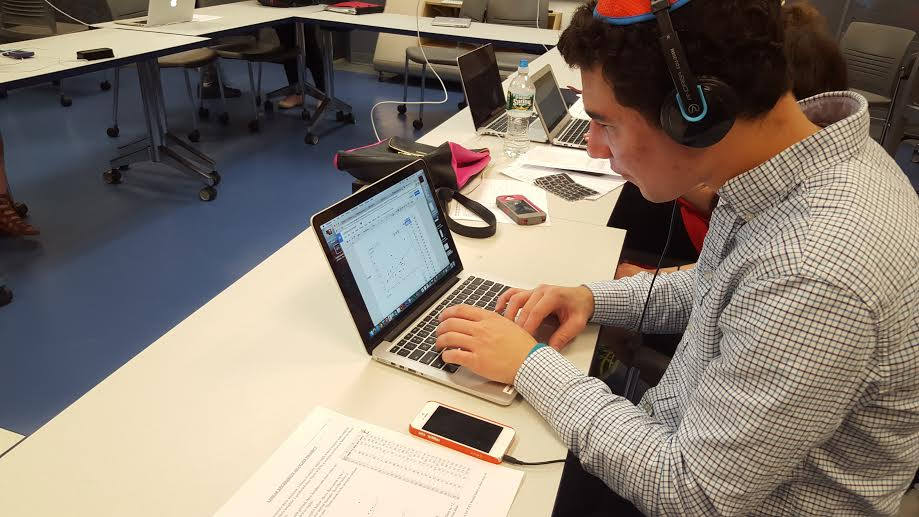
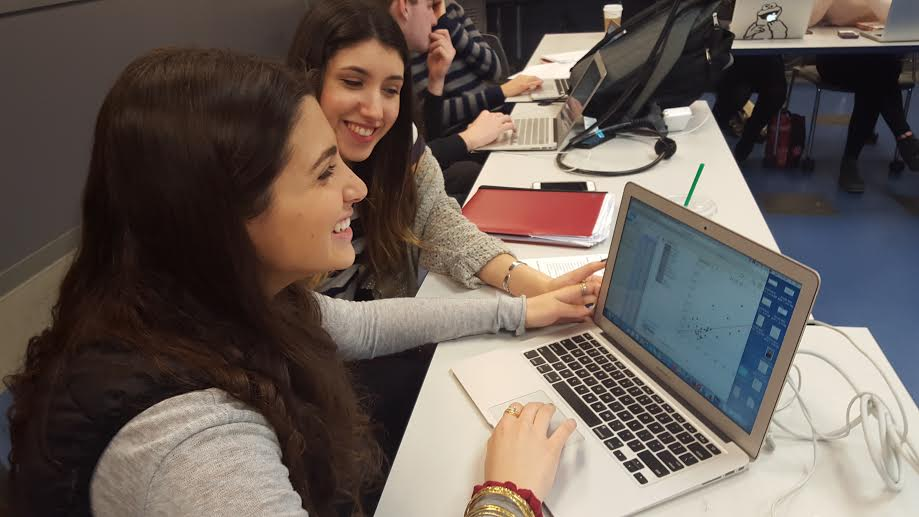
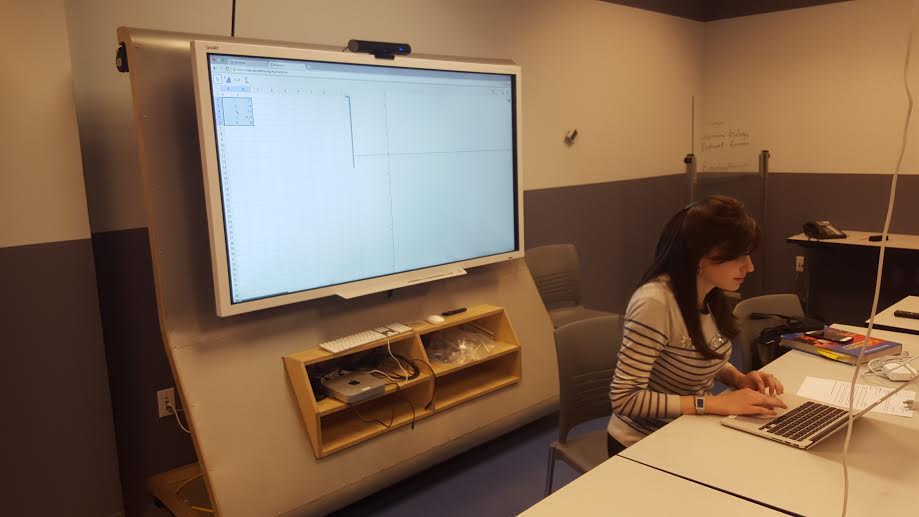
It was then time to curate the data and create a Scatterplot, just as the teachers had done.   The best place to work on this final aspect of the project was in the Smedra 21st Century  Computer Lab, where students used a powerful program called Geogebra to enter their data values, plot points in a Scatterplot, graph the Line of Best Fit, and determine the correlation coefficient to confirm their initial predictions. It was a phenomenal opportunity for the students to analyze Statistics about truly relevant data, and see it come to life in a view other than on the standard graphing calculator.


The beauty of this particular unit was the teacher's ability to make the Statistics come to life through visual representations and make the math more meaningful and hands-on through group projects. While this first run-through was extremely exciting, the teachers are already thinking of ways to refine it for the upcoming year.


Wednesday, January 20, 2016

With Shiriyah hours away...the math department took time to play

Anyone familiar with Frisch knows that our week long celebration and grade level competition called Shiriyah is more than an elaborate color war.  It is multi-facet 100% student created extravaganza of movies, dance routines, murals, banners, and songs highlighting a theme or holiday aspects of Judaism.  It is a chance for our students to learn and work together on a grand scale outside the confines of their classrooms. Though I am a 15 year veteran of Shiriyah, I still find the incredible display the students collaboratively put together simply astounding.


For Frisch teachers, the inherent schedule of Shiryah gives us time to reflect on our progress over the past five months and start to work on our group and individual goals for the remaining part of the year.  The math department used some down time during this past week then to focus on two important topics: the changes in standardized tests and the various uses of technology in our classrooms.

Mrs. Sabrina Bernath, Frisch Math Department Chair, ran the first meeting which focused on standardized tests. Each teacher was present with a thick packet of sample problems which reflect the new type of questions being asked on the new version of the SAT.  With even more emphasis on linear equations and students being able to analyze various types of graphs. the department worked on these different sample questions and discussed how to help students improve upon these ever important skills. Members shared their various ideas about how to fit these types of questions into our already packed curriculum.

Additionally, the math teachers focused next on the various topics of the SAT 2 level 1 and level 2 subject tests.  They examined closely the various types of questions being asked about functions, conics, rational functions, sequences/series, and any other advance topics on each exam.  Comparing the two exams brought to light their different focuses which is not obvious just from reading descriptions of the tests on the College Board website. Not only are the list of tested topics slightly different between the exams but also the emphasis on how to apply that material varies also.

This PD refresher on what our top level math students need to learn to be successful on these exams was a productive and effective use of time.  While we are not solely prepping students for outside tests, it is important to keep in mind the various skills sets measured by these external assessments.


The second PD meeting of the department focused on three specific apps /programs different members of the department are currently using in their classrooms.  Prior to the meeting, teachers were asked to fill out a survey answering questions about the use of technology in their classrooms for administrative duties, to instruction to assessment.  Based on those results, various members of the department were asked to present.

First, Sabrina Bernath showed the functionality of a rubric she created for her twelfth grade Precalculus video project. The rubric is an embedded part of her Haiku gradebook and not only can she enter a grade using the various subsections of the rubric, she demonstrated also how she can leave comments for each criteria. Once the grade is made public, student can not only see their grade but also comments from the teacher.  The members of the department were excited by this enhanced feature and the extensive customization you can do with it.

Next Katya Gourge, a first year teacher at Frisch, showed her incredible creations using Geometer's Sketchpad.  Ms. Gourge makes unique and elaborate demonstrations  to teach her ninth grade Geomtry students many of the most difficult properties and theorems of the course.  Her one of a kind creations help students visualize the theorems and ideas the course. Her skill set with the program is impressive and the members of the department immediately requested further PD time to learn more from her about incredible program.

Finally, Michael Gatto, another first year teacher at Frisch, highlighted key features of GeoGebra.  This program has even greater capabilities to help students visualize topics not just from Geometry but all areas of mathematics with pre-made templates and user- friendly interface that allows teachers to easily to create their own custom programs.  With the incredible accessibility for both teachers and students as a free Web based program, the members of the department also requested extensive PD later this year and into the summer with this program. Though the meeting ended after an hour, several teachers continued the discussion in another locations and Mr. Gatto continued teaching several of the other math teachers how to use GeoGebra in their classes.

As we begin the winter break, the math teachers at Frisch are already looking forward to returning.  They can't wait to show their students all their worked on during Shiriyah also.  Maybe not as exciting as the students' stomp routines but just as important to their overall education.

Tuesday, December 8, 2015

The Frisch Math Team - the most impressive athletes on campus!

Frisch is proud to have many boys’ and girls’ winning sports teams.  From our back to back champion boys’ varsity baseball team to our three time yeshiva league girls’ volleyball team, there is a lot of competing and winning that occurs with Frisch athletes. There is another team at Frisch though that is not as well known but is also competing and winning all the time….The Frisch Math League Team!


The Frisch Math League is comprised of around 20+ students from all four grade levels.  With plans to create our own team jersey, this group of math minded young men and women are bright, determined, and eager to show their academic prowess.  The team has already had an activity filled year with more events planned for the next few months.


For those of you who don’t know, Frisch competes in two yeshiva Math bowls, one at SAR and another at Heschel.  These two events are highlights of the year where students get to compete against the best and brightest math students in the greater yeshiva community.  Just as many people know of the student athletes in basketball or hockey, so too do these students know of the best math minds at other schools.  With awe and admiration, they relish the chance to compete head to head or mind to mind shall we say with their friends and peers in these intense all day math competitions.


The Frisch math team also takes part in the New Jersey Math League.  Just this week the team took exam #3  out of six administered by the state high . A sample question from an exam last year is the following:


“Suppose a hotel has rooms numbered 1-14 and keys also numbered 1-14 BUT the room numbers and key numbers do not have to match. Instead, the keys are assigned to the rooms so that the sum of the room number and the key number is always an exact multiple of 3. How many ways can this be done ?


(The answer is 345,600)”


The five highest scores are entered into a state database and we are ranked against some of the best private and public high schools in the state.  We are proud to say that we even had a 6/6 ( a perfect score) on the first exam this year from a freshman!  Few students if any will score a perfect 6/6 in their entire high school careers but Frisch students have done that impressive feat repeatedly!


photo (15).JPG
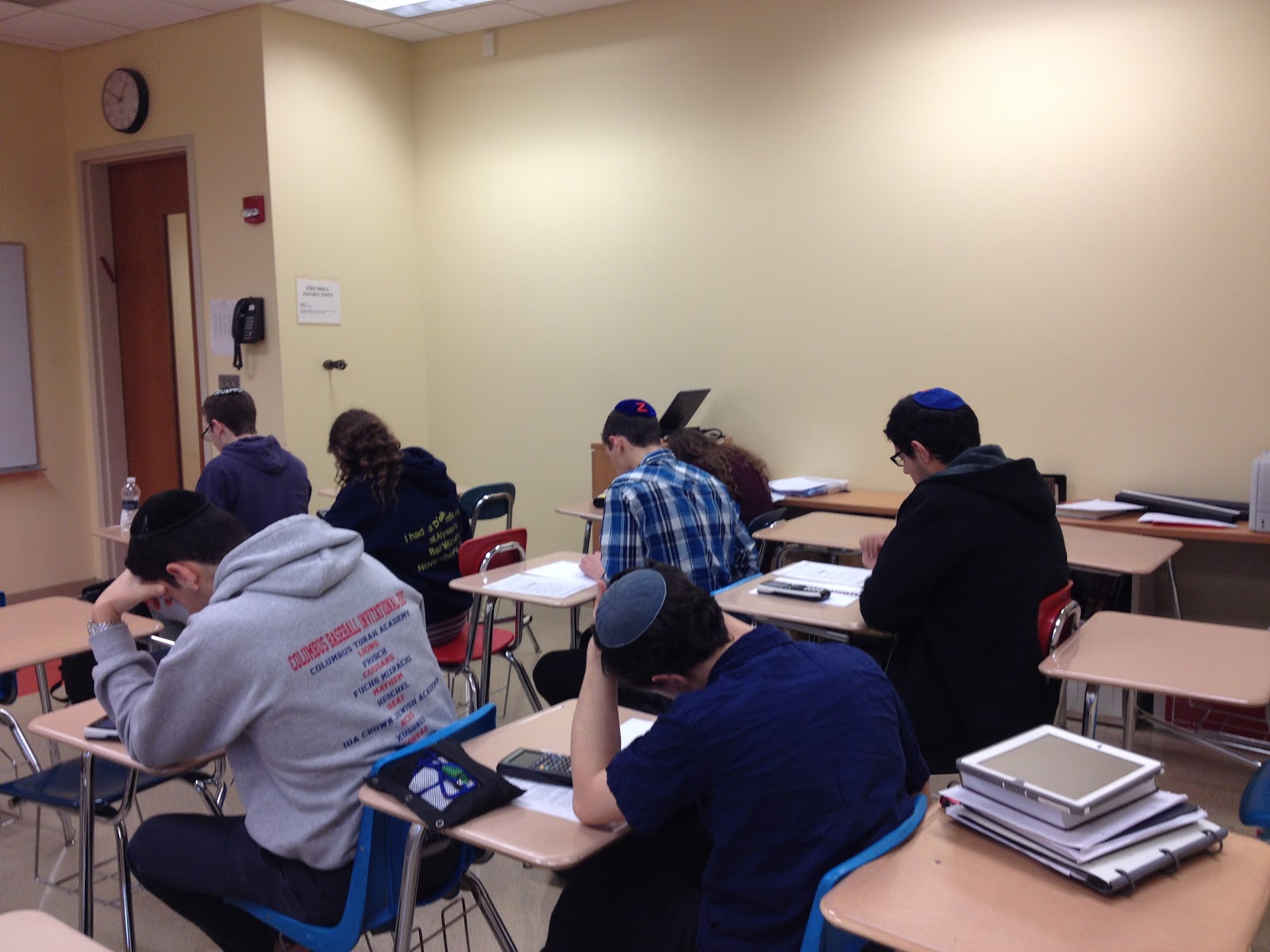
Math Team Athletes taking a New Jersey Math League Exam

The Math Team has many future events coming up including the AMC 10 and AMC 12 exams in February and a possible shabbaton/yeshiva math competition at Yale University in April.  Always eager for more opportunities to do math competitively, the team enjoys a full plate of activities.


Besides competing in various state and national competitions, the Math League also meets twice a month after school.  The sessions vary between practicing for the various math competitions to listening to presentations from guest speakers.  This past math team meeting Frisch faculty member Mr. Herb Grossman presented on the Binomial Theorem.  It was a fascinating talk which the students loved.  They have already requested that he come back no less than two more times to discuss possibly determinants and conic sections. Future presenters will include Mrs. Rhona Flaumenhaft of the Frisch math department discussing polar coordinates and the team’s own president Gabriel Dardik ‘16 who will be speaking about non-Euclidean Geometry.

The remainder of the year for the Math Team will be fun, educational and full of numbers….exactly how these athletes like it!  

Monday, November 30, 2015

9th grade Centroid Activity by Frisch math teacher Debbie Stein


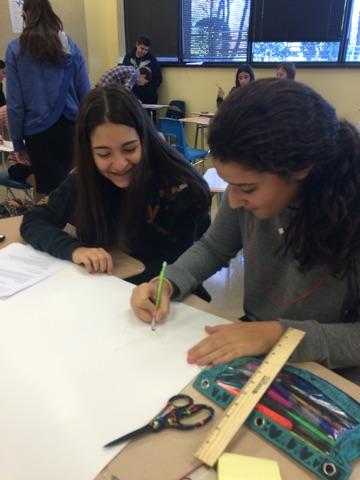
One of my favorite ways that I like to enhance instruction in my math classroom, particularly in Geometry, is by using hands-on learning with my students.  This  has them in effect learn by discovery.  Nothing beats watching my students as they actively engage in the learning process by exploring concepts, answering questions and discovering new relationships.   As they work in cooperative groups I can see their confidence and self-esteem grow as they assume responsibilities within the team. In addition to this, I usually find that my students show higher comprehension of the concepts that they discovered on their own.

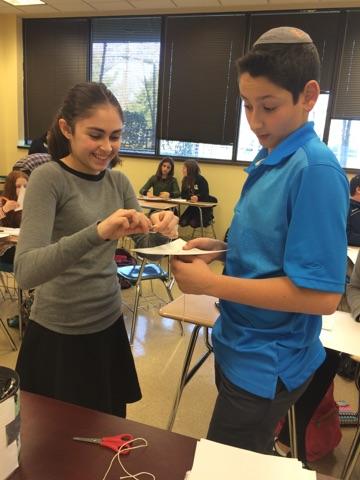
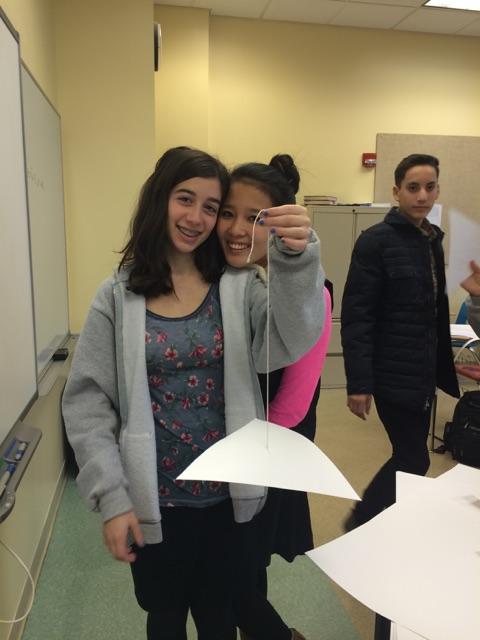
I introduced this activity to my students after we discussed the median and midpoint of a triangle.  I then explained to them that the centroid of a triangle is the center of gravity for a triangle.  The students were assigned a group where they constructed triangles, located the midpoints of each side of the triangle, drew in medians and then located the centroid which happens to be the intersection of the medians of the triangle.  The students were able to prove that the centroid is the point of balance by threading a knotted string through the centroid and watching their triangle balance as they held up the string.

C:\Users\debbie\AppData\Local\Microsoft\Windows\INetCache\IE\IECTL90T\IMG_3466.jpg


I then had each group measure and record the distances from the midpoint to the centroid and the centroid to the vertex of the triangle.  The students were excited to see and discover a pattern!  They came to realize through the hands-on lesson that the distance from the centroid to the vertex of a triangle will always be twice the distance from the midpoint to the centroid of a triangle.C:\Users\debbie\AppData\Local\Microsoft\Windows\INetCache\IE\G7Y3NPXJ\IMG_3458.jpg


As an extension to this activity, the students went through a process of locating the center of balance for an L-shaped figure.  Students were quick to discover, as they all created L-shapes of different sizes, that while the centroid of a triangle must always lie inside the triangle, the centroid of an L-shaped figure will not always lie inside the shape.

It was  a fun and educational activity for  my 9th grade class  right before Thanksgiving break. They really  “learned  by doing”!

Displaying IMG_3458.jpgC:\Users\debbie\AppData\Local\Microsoft\Windows\INetCache\IE\UN3TSATT\IMG_3470.jpg

Sunday, October 25, 2015

"GoFormative" " New Technology for a New School Year


In many classrooms, formative assessments are given during the learning process in order to modify teaching and learning activities to improve student attainment, but are difficult to administer and grade in a timely fashion without the assessment's initial purpose getting lost. Goformative.com, a new website that I learned about during ISTE this past summer, has transformed the way in which I assign and grade formative assessments. "Formative" is a user-friendly website which allows teachers to create original or embed preexisting material into short assessments. A simple quiz takes only minutes to create. 

Formative

Intervene in the moments that matter most.


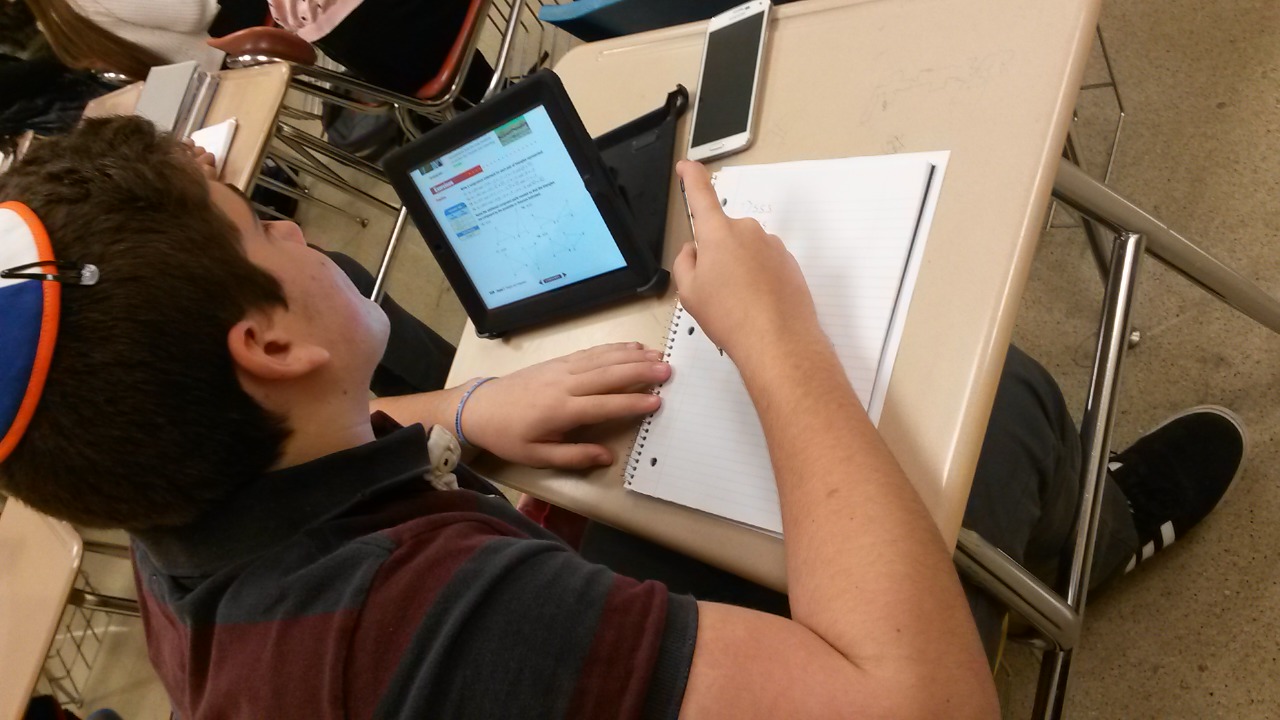
The true beauty of "Formative", though, is the ability to grade - and send feedback about - students' results in real-time. Students were enthused to receive scores and feedback instantly, and as a teacher I find it exhilarating to see and mark students instantly. The first time that I launched the website, I showed the results on the SmartBoard, capitalizing on the pulsing excitement in the room. 


I've been in constant contact with the founders of Goformative.com since my discovery of the website - from a private Google Hangout with one of the primary founders, tweets with them on Twitter, and live chats where I have asked specific questions and received specific responses via email. I look forward to using this program throughout the year and tracking students' progress in a more efficient and exciting way. 

by Mrs. Shira Techiman
Math Teacher and Enthusiast

Tuesday, August 4, 2015

Summer is a fabulous time to learn!

The Frisch Math Department once again is having a successful and productive summer. Various members of the department have taken advantage of a little down time to brush up on their own teaching and technology skills.  Teaching is truly a 12 month job for professionals are serious and devoted as the Frisch Math Department.

The summer learning got off to a great start when Elissa Katz, Shira Teichman, Rhona Flaumenhaft, Sabrina Bernath along with seven other Frisch faculty members attending the ISTE 2015 conference in Philadelphia at the end of June.  The annual three day conference is the the singlest largest edtech gathering of teachers and vendors in the country.  From large ( 400+) lecture sessions to small group settings in the Playground section, Frisch math teachers learned from expert in the field of educational technology and pedagogy.  Besides several hundred daily sessions on blended learning, flipped classrooms, real time assessment to choose from, teachers walked the Expo floor to learn about the latest software and apps in the marketplace. It was an exhausting and inspiring trip that each one of us walked away from with many new and exciting ideas. We can wait to try out all that we learned.

Here is a photo of Rabbi Pittinsky, Director of Educational Technology, Dr.Mindy Furman, Head of the Science Department, Rifki Silverman, Head of Engineering, Ahuva Mantell, Head of the Arts Program, and Rhona Flaumenhaft, math department faculty member up late at night learning how to set up Twitter accounts.

Frisch Faculty collaborating and learning into the night.


A week after ISTE, Frisch math faculty member Elissa Katz was yet again back in school learning.  She attended a week long College Board summer session on AP Statistics at Fordham University. Besides learning the recent changes to the exam, Elissa was given a chance to relearn many ideas from her graduate studies in Statistics with the benefit of newer and more advance technology. She said the teacher and course were "amazing".  Here is a cute picture of her working hard  in one of the sessions.


A highlight of the Frisch calendar for teachers is actually August when Rabbi Tzvi Pittinsky, the Director of Educational Technology, runs his one of kind Technology Boot Camp. His month long schedule of progressive and innovative sessions are highly anticipated each year as teachers look forward to learning from a recognized expert in the world of edtech.

This past Monday, six members of the Frisch math department met with Rabbi Pittinsky to learn about and explore Educanon and Formative. Educanon is a web based tool which allows a teacher to create a virtual worksheet for a preexisting video.  Rather than ask questions about the content discussed in the film at the end, Educanon pauses the video and allows the teacher to ask multiple choice, fill in the blank, and free response questions which it then grades and records the results on a teacher dashboard.  It is a powerful tool to assess student's learning.  Formative is an online formative assessment tool.  By giving your students' a class code, students and  their device of choice are automatically  entered into your "online classroom".  All work they perform with their device is visible to the teacher on their iPad or laptop.   With a choir of "oh" and "ahs" as the two programs were demoed, both Educanon and Formative will be sure to be utilized in your child's math classroom this Fall.

Mrs. Teichman demos Formative to members of the Math Department.


With so much excitement building about the upcoming school year, the math department is eager to get things started.  It is going to be a great year and we look forward to working with your child soon!

Tuesday, March 3, 2015

Math Never Hiberates!!!!

While things might be chilly outside the Frisch math department is far from hibernating.  Besides the exciting teaching occurring in a typical school day, there is a great deal of math being explored both by our students and teachers outside of the classroom.


ipadphoto.JPG

The Frisch Math Team has just taken the 5th out of 6 New Jersey math league contest exam. It is an annual series of contests which ask questions not typical in a high school math classroom. On this past exam one question was “ Suppose a hotel has rooms numbered 1- 14 and keys also numbered 1-14 BUT the room numbers and key numbers do not have to match.  Instead, the keys are assigned to the rooms so that the sum of the room number and the key number is always an exact multiple of 3.  How many ways can this be done?”  Not your average problem ...right?  The answer is at the end of this blog.  Many of our mathematically inclined cougars on this popular “ team” have been getting 6/ 6 on these contests which is nothing less than incredible considering that they only have 30 minutes each contest to complete all 6 questions.  


Even students not on our “Math Team” are welcome to take the American Math Contest (AMC 10 and 12) later this month.  The AMC is a 75 minute multiple choice exam to identify the very best math students in the country.  The AMC 10 covers basic algebra and geometry.  The AMC 12 covers all of high school mathematics with the exception of calculus.  Those who qualify based on their scores in the AMC 12 are given the opportunity to compete in the International Math Olympiad.  We hope Frisch will be represented!


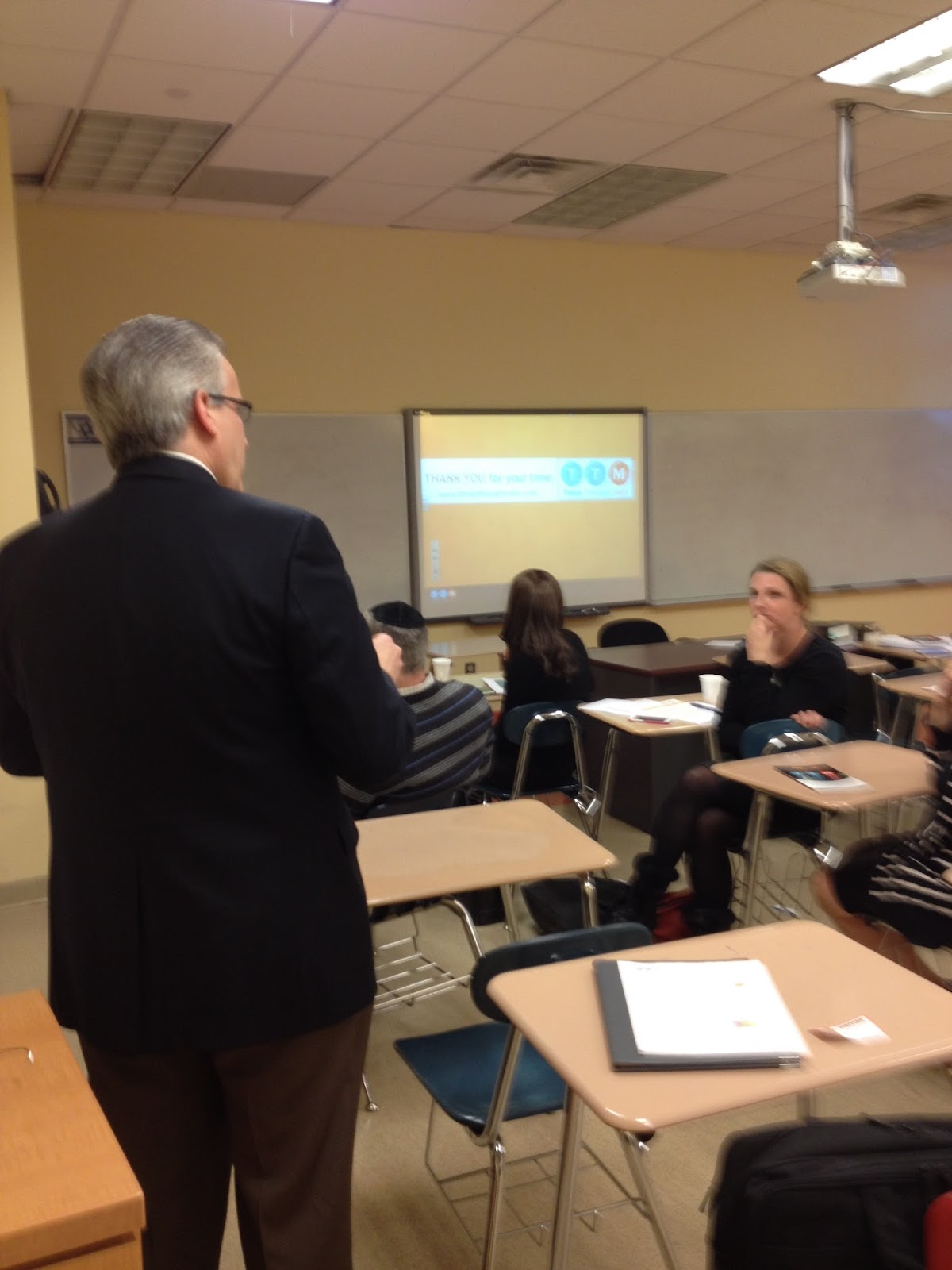
Students are not the only ones busy outside of class time. The teachers of the math department are busy learning about the latest online math programs in their weekly tech meetings.  They recently had an online session with a representative from KnowRe.  This coming week they are having a representative from “Think Through Math”  give an in-person presentation to our whole department.   Texas Instruments and Ten Marks are other vendors they will be meeting in the Spring as they continue to explore the best online math platforms for our students.

photo.JPG


Additionally, to continue to foster their own professional growth, several members of our department will be returning to New Brunswick this March to attend the 29th Annual “ Good Ideas in Teaching PreCalc and…” conference through the DIMAS Center, the Center for Discrete Mathematics and Theoretical Computer Science,  at Rutgers University.  We are honored that our Math Department Chair Mrs. Sabrina Bernath has been chosen to present at this conference for the first time. Her topic is, “The Use of Technology for Differentiated Instruction in Algebra I and Algebra 2”.  She is looking forward to sharing the successful and innovative approaches already being used at Frisch.  


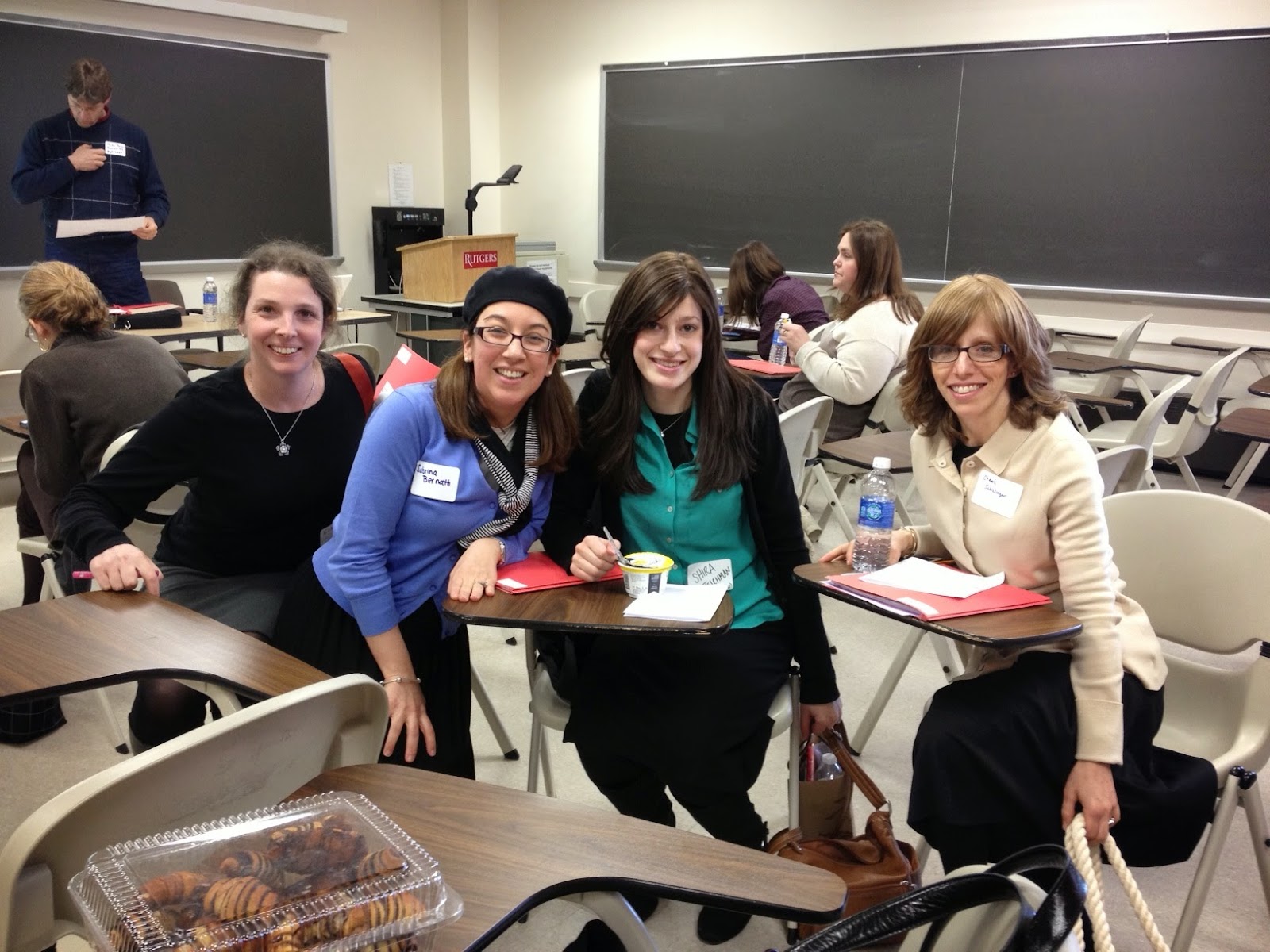
Below is a picture from last year’s PreCalc conference at Rutgers of several Frisch math teachers.  They loved being students once again!
get-attachment.jpg

It is only March so there is still a great deal more math in the coming weeks.  Students and teachers are working hard to have our most productive and successful year yet. By the way the answer to the question about the hotel rooms and the keys is 345,600 but I am sure you already knew that.

Friday, December 5, 2014

Is there more than just giving tests? Reflections on a math PBL by Shira Teichman.


Anyone who knows of my background in Secondary Math Education and/or my current position as a high school math teacher feels obliged, it seems, to email me links to the myriad of math-related articles that are currently riddled throughout Twitter feeds and newspapers.


Many articles have little to no bearing on my teaching (e.g. the private school that I teach in did not need to reorient their curriculum to fit the Common Core), but one recurring topic did truly tug at my pedagogical conscience: TESTS. How much emphasis should we give to students' performance on tests?  Why are tests so anxiety-provoking, to the point that they often hinder students from showing their knowledge masterfully? What are other forms of assessment that can supplement tests? How truthful is the age-old saying, "either you know it [on the test day], or you don't!"?


In an attempt to answer some of these questions, I brainstormed with a colleague and we decided to assign an Independent Study project to be completed once during each of the four terms of this year in two classes that we co-teach. These projects would serve a dual purpose. They would help diminish the weight of tests in the average calculated each marking period. Moreover, these projects would give students the opportunity to apply some of the skills they were learning to real-world scenarios, thereby reinforcing knowledge in the context of an interesting topic of study. 


My "grade-level" sophomore Algebra 1 class does not cease to amaze me; all of them were receptive to, and most of them were quite enthused by, this idea. The students were allowed to choose from a list of topics of study - ranging from the distance from Earth to the Sun during a year's perihelion, to unit pay rates of entertainers like Leonardo DiCaprio as compared to athletes like Koby Bryant. 


The beauty of this Independent Study was that both the teachers and the students worked independently. Once they chose a topic, the students accessed and printed accompanying worksheets from our class website and answered the questions that followed a graph, article, or excerpt of information. Although they were allowed to confer with teachers and classmates, or look on the web for help, students could complete the assignments entirely on their own. Furthermore, as teachers, we worked very "independently"; these assignments were taken from excellent websites such as yummymath.comilluminations.nctm.com, and mathalicious.com, which our Math supervisor mentioned briefly in a summer professional development session after she met some of these site-writers at the ISTE Convention.   


We were amazed with the results of these projects. When we eliminated the build-up of pressure and the frantic race against the 40-or-so minute timer that accompanies a test, the students produced work that showed self-motivationcreativitythoughtfulness,application and retention of skills, and mathematical rigor. We are particularly proud to see our sophomores strengthen their ability to learn and produce mathematical work independently of a structured classroom lesson. Aren't all of these components what we math teachers strive to see students display on a test...?  


Tuesday, November 11, 2014

Blended Learning: The New Normal for Math at Frisch


The math department at Frisch is using technology in exciting and educationally progressive ways.  From real-time assessments to flipped classrooms, our students are being taught using various modes and the feedback and results have been wonderful.

Digital Storytelling: Math Style

In my and Mrs. Elissa Katz’s 12th grade Precalc classes, students have started creating short videos on various self-selected topics listed on a google spreadsheet  The videos created will eventually become part of a video library future Frisch students who take Precalc can utilize.  The students are graded based on a rubric provided by the teachers beforehand and the grade on the video correlates to a test grade. Here is an excellent video by Frisch student Debra Paul ‘15 on solving for the roots of a quartic equation when given one root. Students appreciate the opportunity for an alternative assessment and are honored to be part of the first of many future video libraries of Frisch math classes.

Feedback in Real-Time

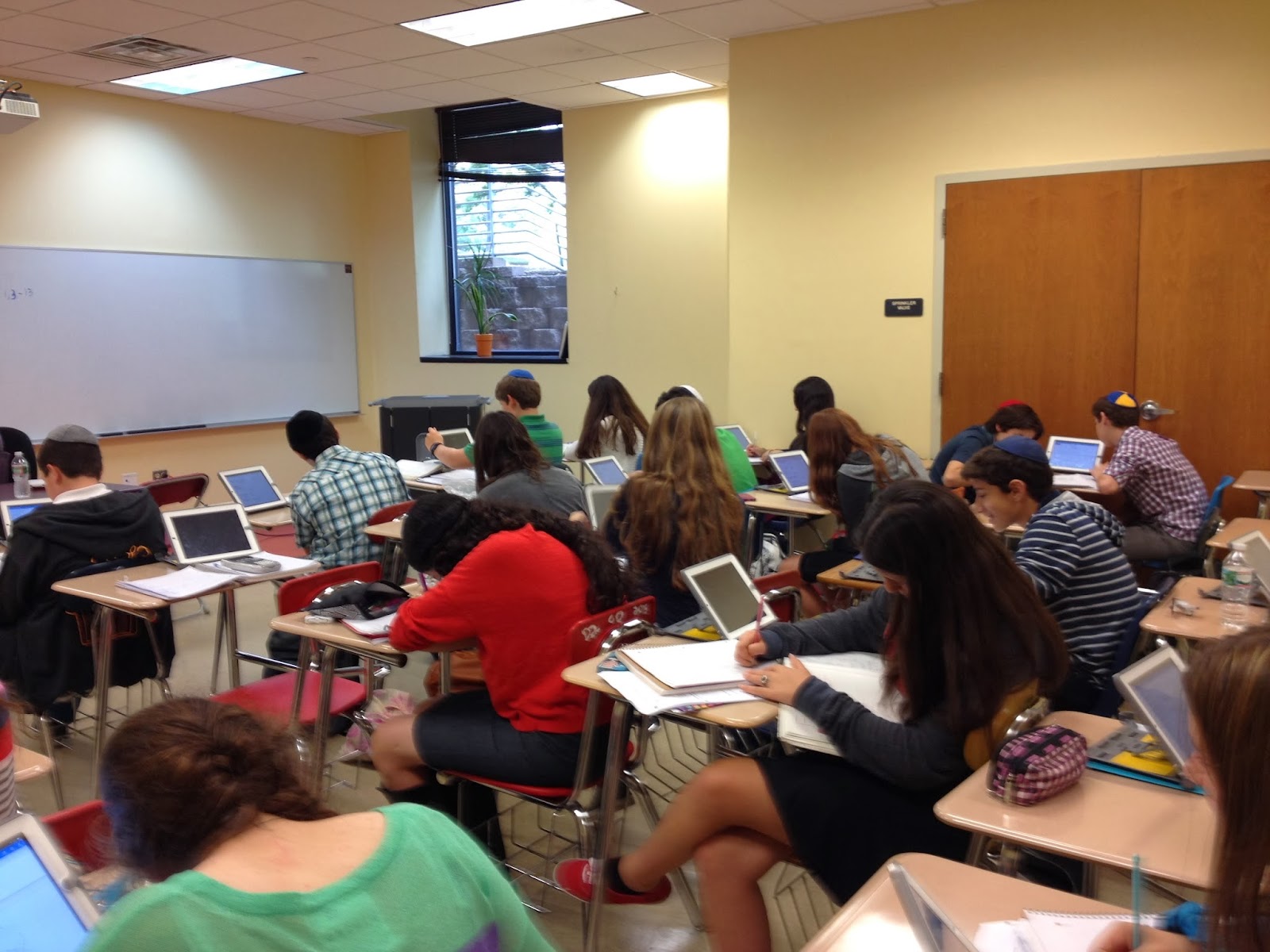
In several of the 11th grade Algebra 2 courses, students were given a review sheet with a QR code for this past week’s test.  After completing the problems on the sheet, students submitted their answers via the QR code and got immediate feedback of their grade on this mock assessment. The students’ scores on the review sheet were also emailed to the teachers who gave a participation grade which will then count towards the students’ average. These juniors, many of whom have started studying for the SAT or ACT, have grown accustomed to practice tests and were happy to see that model reflected in their math course.  The day of the exam, students commented that they felt relaxed walking into the test since they already had received quantitative proof confirming they knew the material.  Other students liked the fact that they had prior knowledge of what to work on before the actual test.  Often students don’t know the material as well as they think they do and the problem specific knowledge gained by the real-time assessment positively guided the rest of their review work

Flipping the Classroom

Additionally in a 10th grade honors algebra 2 course my students are starting to learn about piecewise functions from a “Show Me” video I created. Students were also given a worksheet modeled after the examples in the video to work on at home.  The next class was used for further developing the topic rather than introducing it.

  20141106_113149

Self Check Quizzes

The ninth grade Geometry classes of Mrs. Katz, Mrs. Shira Teichman, Mrs. Debbie Stein and Mrs. Chanie Schlesinger have their own unique blended learning opportunities.  The textbook they use has a rich online component.  The students regularly are assigned online self-check quizzes which correlate exactly to the section and topic they are currently learning.  The immediate feedback gives these students and their teachers are better understanding of what exactly the students understand and what they need further review on. It directly affects the pace and depth of the instruction specific to each class of students.

  Math 2 (1)

Differentiated Instruction

Through a grant from the Digital Jewish Network, the first blended learning platform used school wide at Frisch is now in its first year. About 200 students are enrolled in some way in a program created by Educaide.  Two senior classes are in a college preparatory program which reviews skills from Geometry to Algebra 2 based on a student’s performance on an initial diagnostic test.  This differentiated coursework helps prepare the students for future math placement tests at their respective colleges and university.  Several 10th grade classes are enrolled in the program as an extra avenue for test review.  The teachers create a custom problem set tailor to the topics on the upcoming test.  The program gives immediate feedback to both the student and the teacher about their performance on the problem sets. Lastly, some of our students with greater challenges in the basics of math are enrolled in skill building courses which review and solidify basic algebra skills concurrently while they learn Geometry.  It is truly differentiated education at its best.

Other 21st Century Tools

While as shown above there are many large scale blended learning initiatives taking place in the department, individual teachers are also branching out from the traditional reliance on just the textbook.  Teachers are using Desmos, Smart Notebook Math Tools, the Ti Emulator among many other apps and programs.

Math 3

Professional Development

With a strong emphasis on professional development particularly in the area of blended learning, the math department of Frisch bears little resemblance to class just a few years ago and is growing and advancing at a quick pace.  There is still present of course the warmth, support, and humor that has always been a hallmark of the Frisch math department.  Looking forward to future posts about more of the exciting adventures in Frisch math classes!

 -By Mrs. Sabrina Bernath Chair, Math Department

Crossposted from Frisch.org